Retatrutide Peptide: Evidence, Results and Current Status
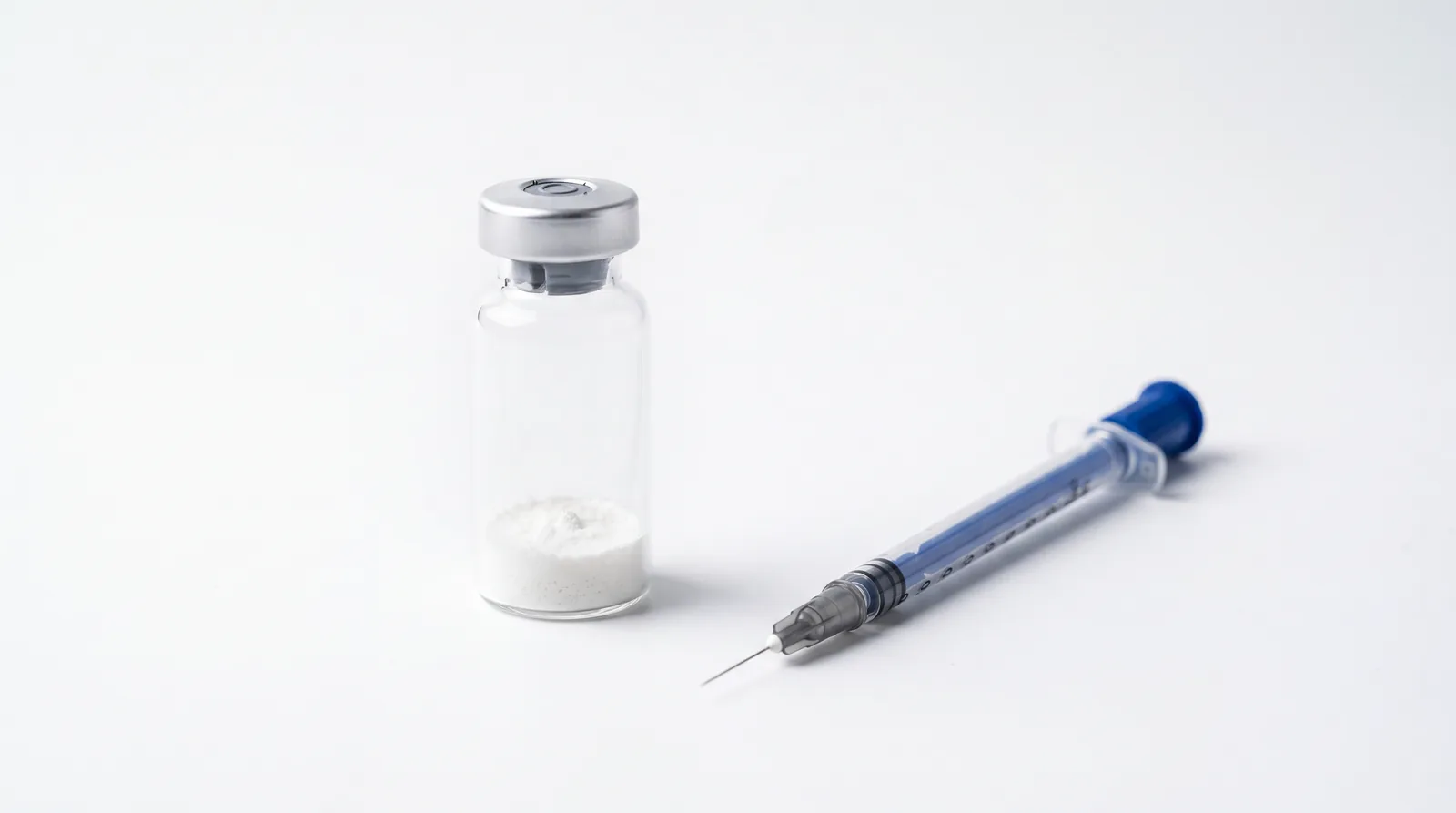
Retatrutide is the most effective obesity compound yet reported in a clinical trial, and it cannot be prescribed to anyone. Both halves of that sentence explain why it generates so much search traffic and so much bad information. This page is the overview; the detailed guides are linked below.
Retatrutide at a glance
- What it is
- An investigational peptide from Eli Lilly, development code LY3437943, that activates three receptors at once: GIP, GLP-1 and glucagon — atriple agonist. Online shorthand for the retatrutide peptide is simply "reta" — reta peptide, GLP-3 and RTA all refer to the same molecule.
- Where it stands
- Phase 3 (the TRIUMPH program). Not FDA approved — no prescription pathway, no legal compounding route. Lilly has stated it plans to file for approval in Q1 2027; details in access & approval timeline.
- What is proven
- Peer-reviewed Phase 2: −24.2% mean weight at 48 weeks (highest dose). Company-reported Phase 3: up to −28.3% at 80 weeks on the efficacy analysis — topline, not yet peer-reviewed. Full breakdown in the results table below.
- What is not established
- Long-term safety beyond the trial windows, results outside trial populations, and any approved use. Dose-by-dose adverse-event rates are inside effects; trial dosing indosage & titration. Sourcing questions belong on thesupplier comparison.
What makes it different
Incretin drugs are usually described by how many receptors they hit, and the count has been climbing:
| Compound | Receptor targets | Best trial result | Status |
|---|---|---|---|
| Semaglutide | GLP-1 | −14.9% at 68 weeks | Approved |
| Tirzepatide | GIP + GLP-1 | −20.9% at 72 weeks | Approved |
| Retatrutide | GIP + GLP-1 + glucagon | −28.3% at 80 weeks | Phase 3 |
The glucagon receptor is the addition that matters. GLP-1 and GIP activity work largely through appetite and satiety — they make eating less feel manageable. Glucagon activity increases energy expenditure and mobilizes fat from the liver, which adds a second mechanism rather than a stronger version of the first. That is the pharmacological argument for why the numbers are higher, and it is also why trials watched heart rate and liver enzymes more closely.
The results, in order
| Trial | Population | Duration | Weight reduction |
|---|---|---|---|
| Phase 2 | Obesity, n=338 | 48 weeks | −24.2% (12 mg) |
| Phase 2 | Type 2 diabetes | 36 weeks | −16.9% |
| TRIUMPH-1 | Obesity, no diabetes, n=2,339 | 80 weeks | −28.3% efficacy / −25.0% treatment-regimen |
| TRIUMPH-1 extension | Subgroup, n=532 — see below | 104 weeks | −30.3% efficacy / −29.9% treatment-regimen |
| TRIUMPH-2 | Type 2 diabetes + obesity, n=1,152 | 80 weeks | −20.8% efficacy |
| TRIUMPH-3 | Severe obesity + established cardiovascular disease, n=1,949 | 80 weeks | −22.6% efficacy |
One pattern is worth noticing across all of them: the weight curve had not flattened when Phase 2 ended at 48 weeks, and the longer Phase 3 follow-up kept descending. Earlier incretin trials plateaued considerably sooner.
Two further limits on all of the Phase 3 numbers above. None of the TRIUMPH results is peer-reviewed yet — they come from Lilly press releases and conference presentations, which is a weaker tier of evidence than a published paper and can change on the way to one. And for TRIUMPH-2 and TRIUMPH-3, Lilly published only the efficacy estimand, so there is no treatment-regimen figure from those two trials to compare against anything.
Note which retatrutide figure is in that chart. It is 25.0%, not the 28.3% or 30.3% quoted above — because every other bar comes from the analysis that counts participants who stopped the drug early, and mixing conventions is how retatrutide's lead gets quietly inflated by two or three points. The sponsors do not help here: Lilly calls this analysis the treatment-regimen estimand and Novo Nordisk calls it treatment policy, and each has a different name again for the adherence-assuming version.
One caveat the chart still cannot fix: the trials ran for different lengths, and retatrutide's 80 weeks against semaglutide's 68 is a real advantage in the numbers that has nothing to do with the molecule. Ourranked comparison lays out both conventions side by side.
What it is being tested for beyond obesity
The TRIUMPH program is broader than weight, and it is worth getting the trial numbers right because they are widely mixed up. TRIUMPH-2 is the type 2 diabetes trial. TRIUMPH-3 is the severe obesity and cardiovascular disease trial. TRIUMPH-4 is the knee osteoarthritis trial. Obstructive sleep apnea was not a separate trial — it was studied in nested sub-studies inside TRIUMPH-1 and TRIUMPH-2, enrolling participants with an apnea-hypopnea index of 15 or above, where the reported reduction reached 36.1 events per hour against a baseline of 58.6. Separately, a Phase 2a trial reported an 81–82% relative reduction in liver fat in metabolic dysfunction-associated steatotic liver disease at the 8 and 12 mg doses. The liver finding is a direct consequence of the glucagon component.
The honest summary
Strongest published weight-loss results of any pharmacotherapy. No approval, no prescription pathway, no legal compounding route, and no long-term safety data beyond the trial windows completed so far. Everything sold online is research-grade material that no regulator has evaluated — which makes the supplier, not the molecule, the main variable in whether what you have is what the label says.
The detailed guides
Dosage & Titration
The doses used in Phase 2 and Phase 3, the four-week escalation schedule, and what the 6 mg step is actually for.
Side Effects
What the trials reported by dose: gastrointestinal effects, heart rate, liver monitoring, and the lean-mass question.
Cost & How to Get It
Three routes — trial enrollment, waiting for approval, research suppliers — with real monthly cost by dose.
Supplier Comparison
Four retatrutide suppliers compared on price per mg and published testing documentation, with dated prices.
Retatrutide (RTA) — 10 mg — American Peptides
Not FDA approved; sold for laboratory research only. Our affiliate partner publishes HPLC and mass-spec results per batch — verify the COA for the batch you receive.
We may earn a commission if you buy through this link (at no extra cost to you). Sold for research purposes only.
Frequently asked questions
What is retatrutide?
Retatrutide is an investigational obesity and diabetes drug that activates three receptors at once — GIP, GLP-1 and glucagon. That third target, glucagon, is what distinguishes it from tirzepatide (two receptors) and semaglutide (one), and it is the main reason its weight-loss results are larger.
What is "reta peptide" and what does LY3437943 mean?
Both are names for the same molecule. LY3437943 is Eli Lilly’s internal development code for retatrutide, used in the registry records and early publications. "Reta," "reta peptide," "GLP-3" and "RTA" are informal shorthand used in forums and by research-chemical suppliers. If a product is sold under any of these names, the compound being referenced is retatrutide.
How much weight do people lose on retatrutide?
Phase 2 reported 24.2% mean body-weight reduction at 48 weeks on the 12 mg dose. In Phase 3 TRIUMPH-1, the 12 mg dose reached 28.3% at 80 weeks on the efficacy estimand, or 25.0% on the treatment-regimen estimand. The widely quoted 30.3% at 104 weeks comes from an extension of 532 selected participants who had a BMI of 35 or above, completed the first 80 weeks and tolerated their dose — it is a subgroup figure, not a whole-trial one.
Is retatrutide better than tirzepatide?
On weight reduction alone the trial numbers are higher, but the honest comparison is narrower than the one usually made: the figures have to be matched estimand for estimand and duration for duration, and the two drugs have not been tested head to head. Tirzepatide is also approved, has a far larger safety database, and can actually be prescribed. Retatrutide has stronger reported results and no approval, which is a trade-off rather than a clear win.
When will retatrutide be available?
Eli Lilly has said it plans to submit a Biologics License Application to the FDA in the first quarter of 2027. That is a stated plan, not a filing and not an approval, and a standard review would put a decision in late 2027 or 2028 at the earliest. Until then the only supervised access is a clinical trial.
Research on Retatrutide
11 records in our research database, classified by evidence type:
- HumanRetatrutide for the treatment of obesity, obstructive sleep apnoea and knee osteoarthritis: rationale and design of the TRIUMPH registrational clinical trialsGiblin K et al. · Diabetes, Obesity and Metabolism, 2026
- HumanTRIUMPH-1 Phase 3 topline resultsEli Lilly · Company announcement, 2026
- HumanTRIUMPH-1 sub-study results in obstructive sleep apnoea and knee osteoarthritisEli Lilly · Company announcement, 2026
- HumanTRIUMPH-2 and TRIUMPH-3 topline results and Q1 2027 BLA submission planEli Lilly · Company announcement, 2026
Sources
- Eli Lilly. TRIUMPH-1 topline results, 21 May 2026. Company announcement. Not peer-reviewed; presented at ADA, June 2026.
- Eli Lilly. TRIUMPH-1 sub-study results in obstructive sleep apnoea and knee osteoarthritis, 6 June 2026. Company announcement. Not peer-reviewed.
- Eli Lilly. TRIUMPH-2 and TRIUMPH-3 topline results and the stated Q1 2027 BLA submission plan, 23 July 2026. Company announcement. Not peer-reviewed.
- Phase 3 registry records: TRIUMPH-1 (NCT05929066), TRIUMPH-2 (NCT05929079), TRIUMPH-3 (NCT05882045), TRIUMPH-4 (NCT05931367).
- Giblin K et al. Retatrutide for the treatment of obesity, obstructive sleep apnoea and knee osteoarthritis: rationale and design of the TRIUMPH registrational clinical trials. Diabetes, Obesity and Metabolism, 2026;28(1):83–93. PubMed
- Jastreboff AM et al. Triple–Hormone-Receptor Agonist Retatrutide for Obesity — A Phase 2 Trial. New England Journal of Medicine, 2023;389(6):514–526. PubMed
- Rosenstock J et al. Retatrutide, a GIP, GLP-1 and glucagon receptor agonist, for people with type 2 diabetes: a randomised, double-blind, placebo and active-controlled, parallel-group, phase 2 trial conducted in the USA. The Lancet, 2023;402(10401):529–544. PubMed
- Sanyal AJ et al. Triple hormone receptor agonist retatrutide for metabolic dysfunction-associated steatotic liver disease: a randomized phase 2a trial. Nature Medicine, 2024;30(7):2037–2048. PubMed
- Coskun T et al. Effects of retatrutide on body composition in people with type 2 diabetes: a substudy of a phase 2 randomised trial. The Lancet Diabetes & Endocrinology, 2025;13(8):674–684. PubMed
- Jastreboff AM et al. Tirzepatide Once Weekly for the Treatment of Obesity (SURMOUNT-1). New England Journal of Medicine, 2022;387(3):205–216. PubMed
- Wilding JPH et al. Once-Weekly Semaglutide in Adults with Overweight or Obesity (STEP-1). New England Journal of Medicine, 2021;384(11):989–1002. PubMed
Related reading
- Best peptides for weight loss, ranked by trial evidence
- Peptide reconstitution calculator
- Are peptides safe?