Peptide Reconstitution Calculator
Two numbers decide every peptide dose: how much peptide is in the vial, and how much bacteriostatic water you added to it. Everything else — the volume you draw, the units on the syringe, how many doses a vial yields — follows from those two. Enter them below and the math is done for you.
Formula: concentration = peptide (mcg) ÷ water (ml). Volume = dose ÷ concentration. One unit on a U-100 insulin syringe = 0.01 ml. Values are for laboratory reference only.
The formula, in plain terms
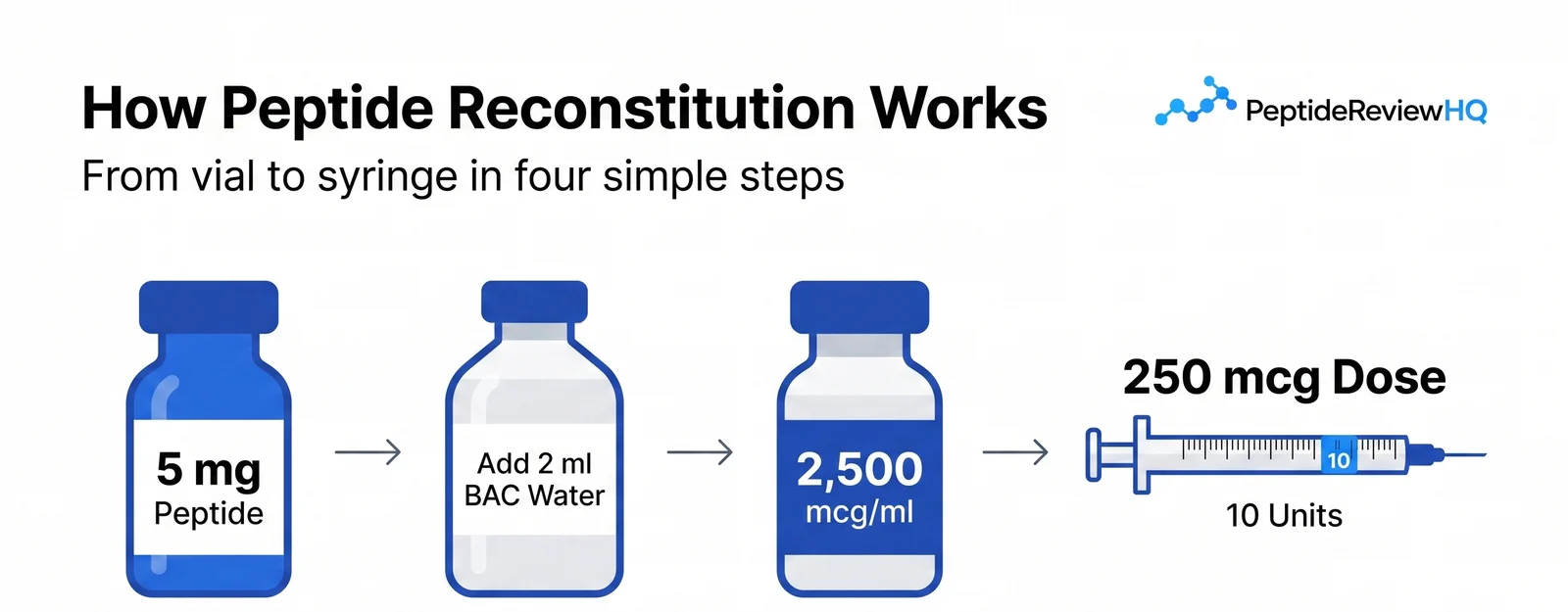
A vial is labeled in milligrams; doses are discussed in micrograms. One milligram is 1,000 micrograms, so a 5 mg vial holds 5,000 mcg. Add 2 ml of bacteriostatic water and the concentration is 5,000 ÷ 2 = 2,500 mcg per ml.
To take 250 mcg from that vial, divide the dose by the concentration: 250 ÷ 2,500 =0.1 ml. Because a U-100 insulin syringe marks 100 units per milliliter, 0.1 ml is 10 units. The vial contains 5,000 ÷ 250 =20 doses.
Reference table: common vial and water combinations
| Vial | Water added | Concentration | 250 mcg | 500 mcg | 1,000 mcg |
|---|---|---|---|---|---|
| 5 mg | 1 ml | 5,000 mcg/ml | 5 units | 10 units | 20 units |
| 5 mg | 2 ml | 2,500 mcg/ml | 10 units | 20 units | 40 units |
| 5 mg | 2.5 ml | 2,000 mcg/ml | 12.5 units | 25 units | 50 units |
| 10 mg | 2 ml | 5,000 mcg/ml | 5 units | 10 units | 20 units |
| 10 mg | 2.5 ml | 4,000 mcg/ml | 6.25 units | 12.5 units | 25 units |
| 10 mg | 5 ml | 2,000 mcg/ml | 12.5 units | 25 units | 50 units |
How much water should you add?
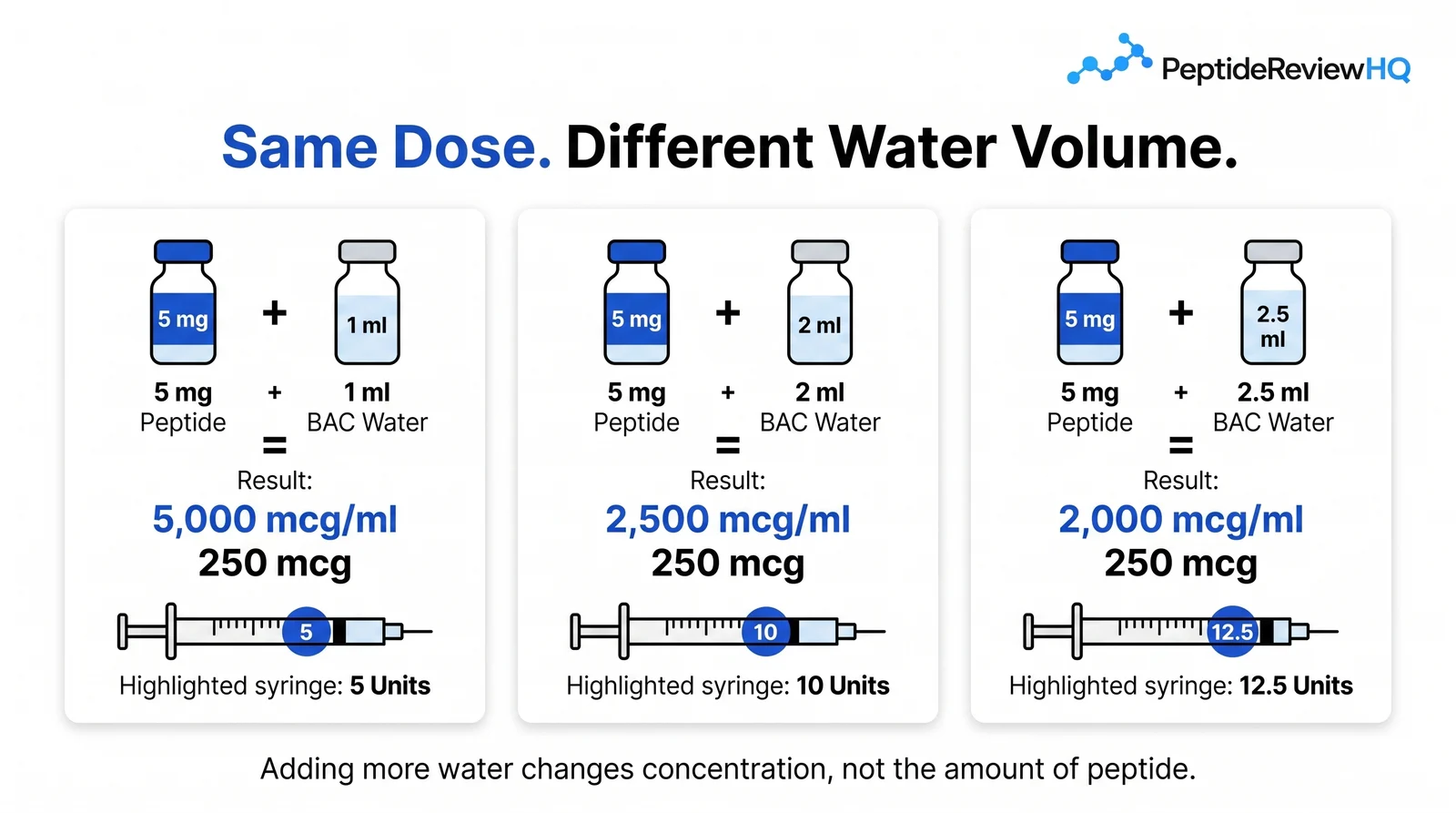
There is no single correct volume — the choice is about measurement precision. Adding more water spreads the same peptide across a larger volume, so each dose is a bigger, easier-to-read mark on the syringe. That matters when a protocol calls for 100–250 mcg: at a very high concentration those doses land in the first two or three units, where small errors are proportionally large.
The practical constraint is the opposite one. A reconstituted vial is typically used within a few weeks, so filling a vial with 5 ml of water only helps if you will actually get through it in that window.
Reconstitution, step by step
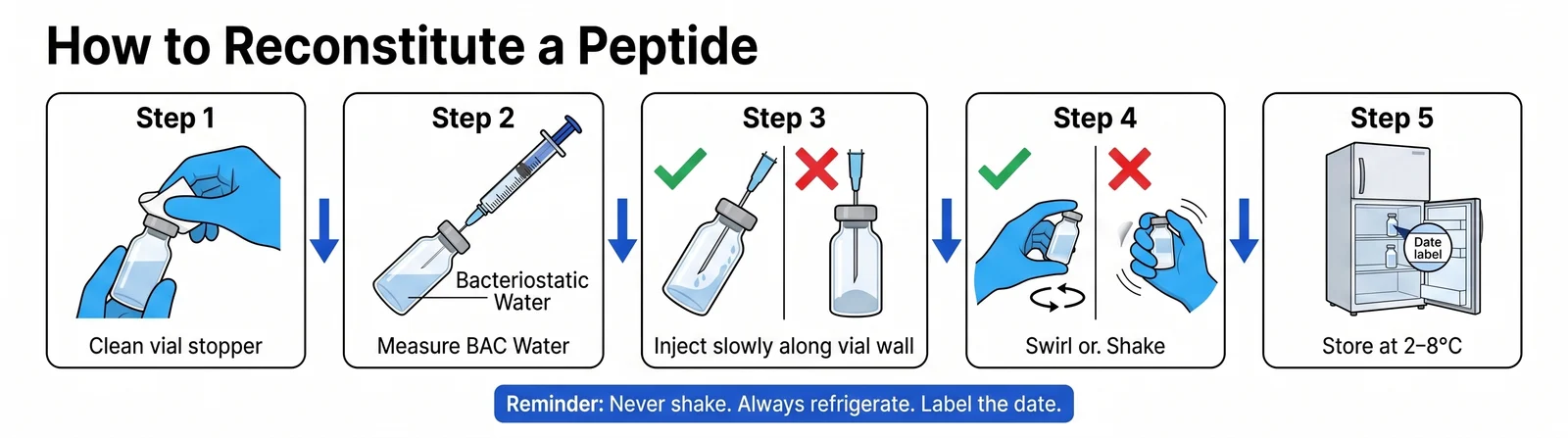
- Let the lyophilized vial reach room temperature before adding liquid.
- Wipe both stoppers with a fresh alcohol pad and let them dry.
- Draw your measured volume of bacteriostatic water.
- Angle the needle so the stream runs down the inside wall of the vial — do not jet it directly onto the powder.
- Let it dissolve on its own, swirling gently if needed. Never shake: agitation denatures and aggregates peptide at the air–water interface, and that damage cannot be reversed.
- Label the vial with the concentration and the date it was mixed.
- Store refrigerated, protected from light.
Mistakes that ruin the math
- Treating units as micrograms. Units measure volume. Ten units of a 5,000 mcg/ml solution is 500 mcg; ten units of a 2,000 mcg/ml solution is 200 mcg.
- Forgetting a blend has two compounds. A 5/5 mg CJC-1295 and ipamorelin vial holds 10 mg total, and each draw delivers both peptides.
- Assuming the label. Concentration math is only as good as the vial's actual content, which is why a batch-specific certificate of analysis matters more than the number printed on the box.
- Shaking to speed dissolution. It degrades the peptide and cannot be undone.
Reconstitution kit — bacteriostatic water, syringes, alcohol pads — American Peptides
The math above assumes bacteriostatic water and a U-100 syringe. If you need the supplies, our affiliate partner sells them as one kit rather than three separate orders.
We may earn a commission if you buy through this link (at no extra cost to you). Sold for research purposes only.
Frequently asked questions
How do you calculate a peptide dose after reconstitution?
Convert the vial contents to micrograms (mg × 1000), then divide by the milliliters of bacteriostatic water you added. That gives concentration in mcg/ml. Divide your target dose by that concentration to get the volume to draw, then multiply by 100 to convert milliliters into units on a U-100 insulin syringe.
How many units is 250 mcg of a 5 mg vial reconstituted with 2 ml?
A 5 mg vial in 2 ml of water gives 2,500 mcg/ml. A 250 mcg dose is 0.1 ml, which is 10 units on a U-100 insulin syringe.
Does the amount of bacteriostatic water change the dose?
No. The water only changes the concentration, not the total peptide in the vial. More water means you draw a larger volume for the same dose, which makes small doses easier to measure accurately.
What is a unit on an insulin syringe?
On a U-100 syringe, 100 units equal 1 ml, so one unit is 0.01 ml. Units are a volume marking, not a measure of peptide mass — the same 10 units can contain very different amounts of peptide depending on concentration.
How long does a reconstituted peptide last?
Once mixed, most research peptides are kept refrigerated at 2–8 °C and used within about 4 weeks; lyophilized powder stored frozen is stable far longer. Stability varies by sequence, so check the supplier documentation for the specific compound.