CJC-1295 and Ipamorelin: Dosage, Benefits and Side Effects
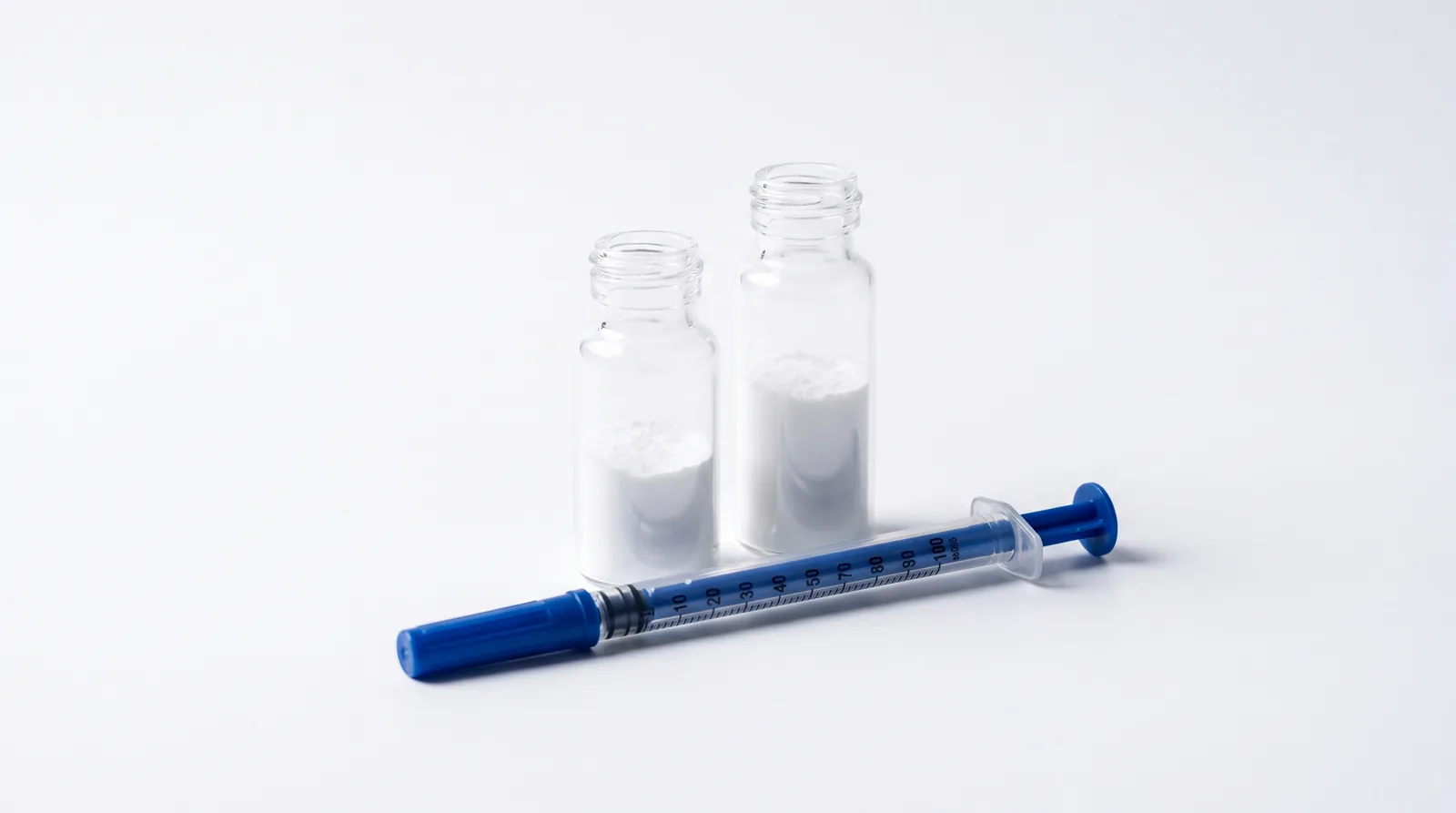
This is the most common peptide pairing in circulation, and the reason is mechanical rather than marketing: the two compounds act on different receptors in the same pathway, so combining them produces more growth hormone release than either does alone. Understanding that division of labour explains everything else about how the pair is used.
What each compound does
CJC-1295 — the GHRH analogue
CJC-1295 is a modified version of growth hormone releasing hormone. Natural GHRH breaks down within minutes; the modifications resist that degradation, so the signal to the pituitary persists. Functionally it increases how much growth hormone is available to be released, and raises the baseline of GH and downstream IGF-1.
Ipamorelin — the selective ghrelin agonist
Ipamorelin acts on the ghrelin receptor (GHS-R), a separate pathway that triggers an acute pulse of GH release. Its advantage over older secretagogues such as GHRP-6 and GHRP-2 is selectivity: it stimulates GH release without the significant cortisol, prolactin and appetite effects those compounds produce. That selectivity is the whole reason it became the default partner peptide.
DAC or no DAC — the decision that matters most
| CJC-1295 with DAC | CJC-1295 no DAC (mod GRF 1-29) | |
|---|---|---|
| Half-life | ~6–8 days | ~30 minutes |
| GH pattern | Sustained elevation ("bleed") | Sharp pulse, then baseline |
| Frequency in protocols | 1–2× weekly | Daily, often at night |
| Physiological resemblance | Lower — continuous exposure | Higher — mimics natural pulsatility |
Natural GH secretion is pulsatile, with the largest pulse during early deep sleep, and receptor sensitivity depends on those troughs between pulses. That is the argument for the no-DAC version: it produces a pulse and then gets out of the way. The DAC version is more convenient and produces a larger total GH exposure, at the cost of resembling normal physiology less.
CJC-1295 + Ipamorelin dosage
Neither compound is approved for this use, so no evidence-based human dose exists. Protocols in research circulation cluster tightly around the following:
| Combination | Common per-dose amount | Frequency | Timing |
|---|---|---|---|
| CJC-1295 no DAC + ipamorelin | 100–200 mcg of each | Daily, sometimes 2–3×/day | Before bed; fasted |
| CJC-1295 with DAC + ipamorelin | 1–2 mg CJC weekly; ipamorelin 200–300 mcg daily | CJC 1–2×/week | Ipamorelin before bed |
| Pre-mixed 5/5 mg or 10/10 mg vial | Draw delivers both together | Daily | Before bed |
One arithmetic warning worth carrying away: a vial labelled 5/5 mg holds 10 mg total but 5 mg of each compound. Dose against the total and you deliver half of what you intended.
Full detail is on the dedicated page:CJC-1295 + Ipamorelin dosage covers the per-compound blend arithmetic with a table for every vial and water combination, how the DAC and no-DAC forms change the schedule entirely, and the physiology behind the fasted-and-before-bed convention.
Cost per month
At 200 mcg of each compound daily, a 5/5 mg blend vial provides 25 doses — roughly three and a half weeks. Research suppliers price these vials in the $40–90 range depending on size and quantity, which puts a month somewhere near $50–100 at typical protocol doses. A 10/10 mg vial usually improves cost per milligram noticeably.
Side effects
The effects reported for this combination are the predictable consequences of raising GH and IGF-1:
- Water retention — the most common report, often in the first weeks.
- Joint discomfort and carpal-tunnel-like tingling — a classic GH-excess pattern.
- Reduced insulin sensitivity — GH is counter-regulatory to insulin; relevant for anyone with glucose issues.
- Lethargy or head-rush after injection — usually transient.
- Injection-site redness — common with daily subcutaneous use.
A theoretical concern worth stating plainly: IGF-1 is a growth factor, and elevating it in the presence of an undiagnosed malignancy is not a neutral act. This is unresolved in the literature rather than settled in either direction.
CJC-1295 + Ipamorelin blend — American Peptides
Available as 5/5 mg and 10/10 mg blends, and as separate vials including no-DAC. Batch COA with HPLC and mass spec. Research use only.
We may earn a commission if you buy through this link (at no extra cost to you). Sold for research purposes only.
Frequently asked questions
What is CJC-1295 and ipamorelin used for?
The pair is studied as a growth hormone secretagogue combination. CJC-1295 is a GHRH analogue that increases the amount of growth hormone released; ipamorelin is a ghrelin receptor agonist that triggers a release pulse. Together they raise GH and IGF-1 through the body's own pituitary signalling rather than by injecting growth hormone.
What is the typical CJC-1295 and ipamorelin dose?
Protocols in research circulation commonly use 100–300 mcg of each compound per administration, once daily, most often before bed to align with natural nocturnal GH release. Neither compound has an approved human dose for this use, so these figures come from practice rather than from trials.
What is the difference between CJC-1295 with DAC and without DAC?
DAC (Drug Affinity Complex) binds the peptide to albumin, extending its half-life from roughly 30 minutes to about a week. Without DAC — often labeled modified GRF(1-29) — the compound clears quickly, which produces a pulse resembling natural GH release. With DAC it raises GH more continuously.
Why is ipamorelin paired with CJC-1295?
They act on separate receptors, so the effect is additive rather than redundant. CJC-1295 increases the size of the releasable GH pool via the GHRH receptor while ipamorelin triggers release via the ghrelin receptor. Ipamorelin is favoured over older secretagogues because it is selective and does not meaningfully raise cortisol or prolactin.
What side effects are associated with these peptides?
Reported effects follow from raised GH and IGF-1: water retention, joint aches, tingling or numbness in the hands, and reduced insulin sensitivity. Injection-site reactions and transient flushing or head-rush after administration are also common in reports.
Research on CJC-1295 + Ipamorelin
6 records in our research database, classified by evidence type:
- HumanThe Safety and Efficacy of Growth Hormone SecretagoguesSigalos JT, Pastuszak AW · Sexual Medicine Reviews, 2018
- HumanSystematic review: the effects of growth hormone on athletic performanceLiu H et al. · Annals of Internal Medicine, 2008
- HumanProlonged stimulation of growth hormone (GH) and insulin-like growth factor I secretion by CJC-1295, a long-acting analog of GH-releasing hormone, in healthy adultsTeichman SL et al. · Journal of Clinical Endocrinology & Metabolism, 2006
- HumanPulsatile Secretion of Growth Hormone (GH) Persists during Continuous Stimulation by CJC-1295, a Long-Acting GH-Releasing Hormone AnalogIonescu M, Frohman LA · Journal of Clinical Endocrinology & Metabolism, 2006
Sources
- Teichman SL et al. Prolonged stimulation of growth hormone (GH) and insulin-like growth factor I secretion by CJC-1295, a long-acting analog of GH-releasing hormone, in healthy adults. Journal of Clinical Endocrinology & Metabolism, 2006;91(3):799–805. PubMed
- Raun K et al. Ipamorelin, the first selective growth hormone secretagogue. European Journal of Endocrinology, 1998;139(5):552–61. PubMed
- Sigalos JT, Pastuszak AW. The Safety and Efficacy of Growth Hormone Secretagogues. Sexual Medicine Reviews, 2018;6(1):45–53. PubMed
- Ionescu M, Frohman LA. Pulsatile Secretion of Growth Hormone (GH) Persists during Continuous Stimulation by CJC-1295, a Long-Acting GH-Releasing Hormone Analog. Journal of Clinical Endocrinology & Metabolism, 2006;91(12):4792–7. PubMed