BPC-157 + TB-500: The Blend, and the Math People Get Wrong
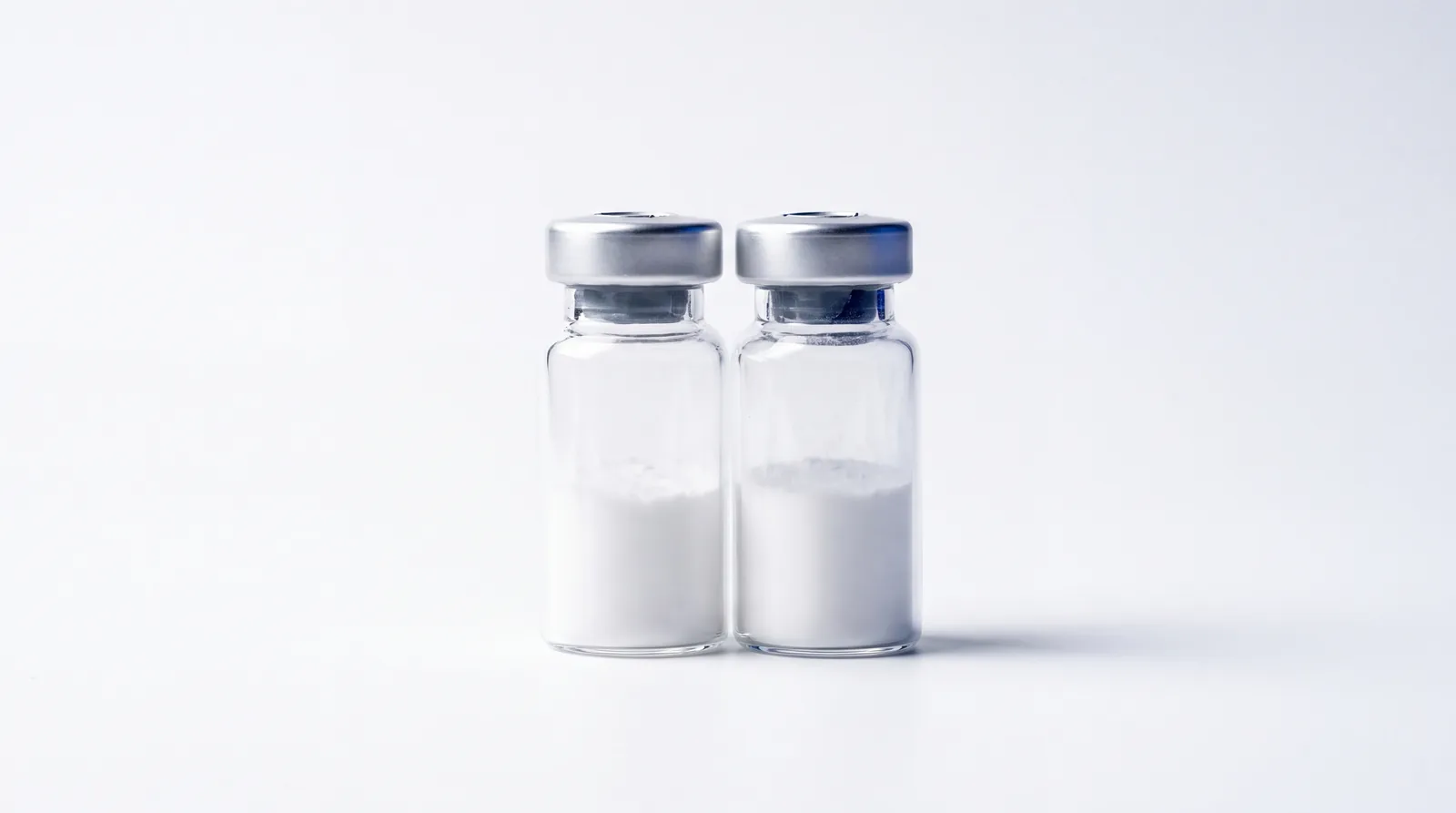
This is the most popular stack in tissue-repair research, sold under names like Wolverine and Repair. It is also the product where dosing errors are most common, and the error is always the same one: treating a 5/5 mg vial as though it contained 10 mg of a single substance. That mistake halves every dose you calculate.
Why the two are paired
The argument for the combination is mechanism diversity rather than additive potency. The two compounds do different things.
| BPC-157 | TB-500 | |
|---|---|---|
| Origin | Fragment of a protein in gastric juice | Synthetic fragment of thymosin beta-4 |
| Primary action | Angiogenesis via VEGFR2, nitric oxide signalling, growth-hormone receptor upregulation in tendon cells | Actin regulation, which controls how cells migrate into damaged tissue |
| Reach | Strong local and gastrointestinal effects | Systemic — protocols do not require injecting at the injury site |
| Strongest evidence | Rodent gut and tendon healing | Animal and veterinary soft-tissue work; parent protein reached human wound trials |
| Administration | Daily; oral viable for gut targets | Loading phase then maintenance; injection only |
Full detail on each is in our BPC-157 guide andTB-500 guide, including the caveats that matter — the unresolved angiogenesis question for BPC-157, and the fact that human trial evidence for TB-500 belongs to the parent protein rather than to the fragment being sold.
Blend vial math
A vial labelled 5/5 mg holds 5 mg of BPC-157 and 5 mg of TB-500 — 10 mg of peptide in total. Every draw delivers both compounds in the ratio they were mixed. So the arithmetic is doneper compound, using 5 mg as the vial figure, not 10.
| Blend vial | Water | Per compound | 200 mcg each | 250 mcg each | 500 mcg each |
|---|---|---|---|---|---|
| 5/5 mg | 2 ml | 2,500 mcg/ml | 8 units | 10 units | 20 units |
| 5/5 mg | 2.5 ml | 2,000 mcg/ml | 10 units | 12.5 units | 25 units |
| 5/5 mg | 3 ml | 1,667 mcg/ml | 12 units | 15 units | 30 units |
| 10/10 mg | 3 ml | 3,333 mcg/ml | 6 units | 7.5 units | 15 units |
The calculator below has a preset for this. Select the blend option and it works per compound — the same basis as the table above, so the two never disagree.
Formula: concentration = peptide (mcg) ÷ water (ml). Volume = dose ÷ concentration. One unit on a U-100 insulin syringe = 0.01 ml. Values are for laboratory reference only.
How the stack is typically run
Protocols in circulation follow the shape of each compound's own convention rather than anything specific to the combination.
| Phase | BPC-157 | TB-500 | Duration |
|---|---|---|---|
| Loading | 250–500 mcg daily | 2–2.5 mg twice weekly | 4–6 weeks |
| Maintenance | 250 mcg daily or stopped | 2 mg every 1–2 weeks | As needed |
One practical consequence of the pairing: because a blend vial fixes the ratio, you cannot front-load TB-500 independently. If a protocol calls for different schedules for each compound — which the loading structure above does — separate vials give you control that a blend does not. Blends buy convenience and cost less; separates buy flexibility.
What to expect, stated carefully
Reports describe faster recovery from soft-tissue injury, and the animal literature supports that direction for each compound individually. What does not exist is a controlled human trial of either compound for tendon or muscle injury, let alone of the two together. Anyone quoting a recovery-time figure is quoting practice, not data.
The safety picture is the same story: no controlled human safety data. Reported effects are injection-site irritation, transient lethargy and occasional head-rush. The structural concern applies to both compounds and is worth restating — each promotes angiogenesis, and new blood vessel growth is what a tumor needs to grow. That is unresolved rather than demonstrated in either direction.
BPC-157 + TB-500 blend — American Peptides
Available as a 5/5 mg blend and as separate vials. Blends cost less; separates let you run different schedules for each compound. Batch COA with HPLC and mass spec. Research use only.
We may earn a commission if you buy through this link (at no extra cost to you). Sold for research purposes only.
Sources
- Mendias CL et al. Safety and Efficacy of Approved and Unapproved Peptide Therapies for Musculoskeletal Injuries and Athletic Performance. Sports Medicine, 2026 — a review covering both compounds; it reports no study of the two in combination. PubMed
- Mayfield CK et al. Injectable Peptide Therapy: A Primer for Orthopaedic and Sports Medicine Physicians. American Journal of Sports Medicine, 2026;54(1):223–229. PubMed
- Chang CH et al. The promoting effect of pentadecapeptide BPC 157 on tendon healing involves tendon outgrowth, cell survival and cell migration. Journal of Applied Physiology, 2011;110(3):774–80. PubMed
- Hsieh MJ et al. Therapeutic potential of pro-angiogenic BPC157 is associated with VEGFR2 activation and up-regulation. Journal of Molecular Medicine, 2017;95(3):323–333. PubMed
- Goldstein AL, Hannappel E, Kleinman HK. Thymosin β4: actin-sequestering protein moonlights to repair injured tissues. Trends in Molecular Medicine, 2005;11(9):421–9. PubMed
- Lee E, Padgett B. Intra-Articular Injection of BPC 157 for Multiple Types of Knee Pain. Alternative Therapies in Health and Medicine, 2021;27(4):8–13 — an uncontrolled case series, and the only primary human report of either compound. PubMed
- Registered but not yet reported: a Phase 2 BPC-157 trial in hamstring strain (NCT07437547) and a Phase 1/2 trial of the TB-500 fragment (NCT07487363), both registered February 2026. Registration is not evidence.
- World Anti-Doping Agency. Prohibited List 2026 — BPC-157 under S0 (non-approved substances, a Specified Substance); thymosin-β4 derivatives including TB-500 under S2.3 (a non-Specified Substance). WADA Prohibited List
- FDA. Certain Bulk Drug Substances for Use in Compounding That May Present Significant Safety Risks — both listed under “nominated but withdrawn.” FDA
Frequently asked questions
What is the BPC-157 and TB-500 blend used for?
The pairing is used in tissue-repair research — tendon, ligament, muscle and gut. The rationale is that the two act through different mechanisms: BPC-157 works largely locally and through the VEGFR2 and nitric oxide pathways, TB-500 works systemically by regulating actin and cell migration.
How do you dose a 5/5 mg blend vial?
A 5/5 mg vial holds 5 mg of each compound, 10 mg total. Every draw delivers both. Reconstituting 5/5 mg in 2.5 ml gives 2,000 mcg per ml of each compound, so 10 units on a U-100 syringe delivers 200 mcg of each. The most common error is treating the vial as 10 mg of a single substance, which halves every calculated dose.
Is there any research on the two used together?
That is the honest weak point. Each compound has its own animal literature, but published studies of the combination are essentially absent. The stack is a practice-based convention built on two separate bodies of rodent research, not on evidence that the pair outperforms either alone.
How long is a typical protocol?
Community protocols usually run four to eight weeks, with TB-500 front-loaded — roughly 2–2.5 mg twice weekly for the first four to six weeks, then a maintenance dose — while BPC-157 is given daily at 250–500 mcg. No human trial has established either schedule.
Are they banned in sport?
Yes, both. TB-500 and thymosin beta-4 derivatives are listed under WADA section S2.3; BPC-157 falls under S0 as a non-approved substance. Both are prohibited at all times, in and out of competition.
Related guides
- BPC-157: side effects, dosage and evidence
- TB-500: dosage, benefits and evidence
- GHK-Cu: the third component of the GLOW stack
- Peptide reconstitution calculator
- Best peptides for muscle growth
- Are peptides safe?